Is Solar Worth It Anymore?
Are there still savings with solar given all the recent changes - is the ROI worth it anymore?

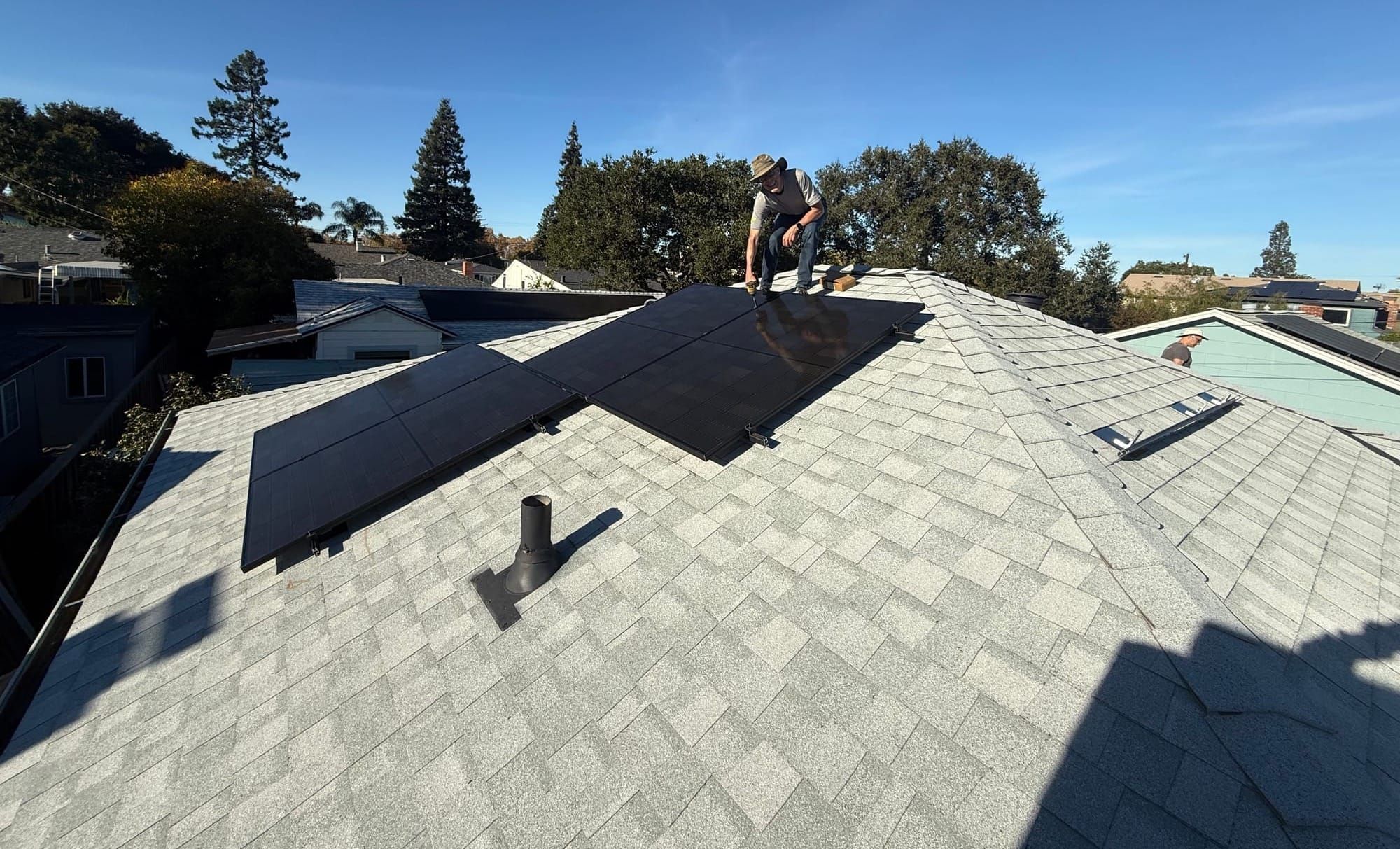
Is Solar Worth It in 2026
There have been big changes (reductions) recently in how solar can help you save money - is solar worth it still?
First, here’s the biggest changes:
- Elimination of the Investment Tax Credit (ITC) for residential solar - prior to 2026, homeowners purchasing solar could receive up to a 30% tax credit for installed solar systems. This was big, as buying a $20,000 solar system would get you a $6,000 credit off your income tax bill. No longer.
- Reduction in credits for excess electricity - Power companies give you credit for electricity that you “send back to the grid” - called net metering, net billing or feed-in tariffs. In the early days of solar, utilities would pay you the same amount for electricity you sent back as they charged for the electricity you used. Not so much anymore. California reduced net metering credits in 2022, and at least nine more states have taken similar actions to reduce net metering credits in 2025.
Given these financial headwinds, is solar still worth it in 2026? The short answer: A qualified “yes” - 1/3 of US homes would save money today by adding solar - but it depends on your specific case.
The big picture: Solar is a "hedge" against high utility prices and rate hikes
Electric rates have risen 50% on average in the last 5-6 years, but not everywhere has felt the same impact. Depending on where you live, electric rates may have gone up a lot, in other areas not so much, as shown in the chart below.
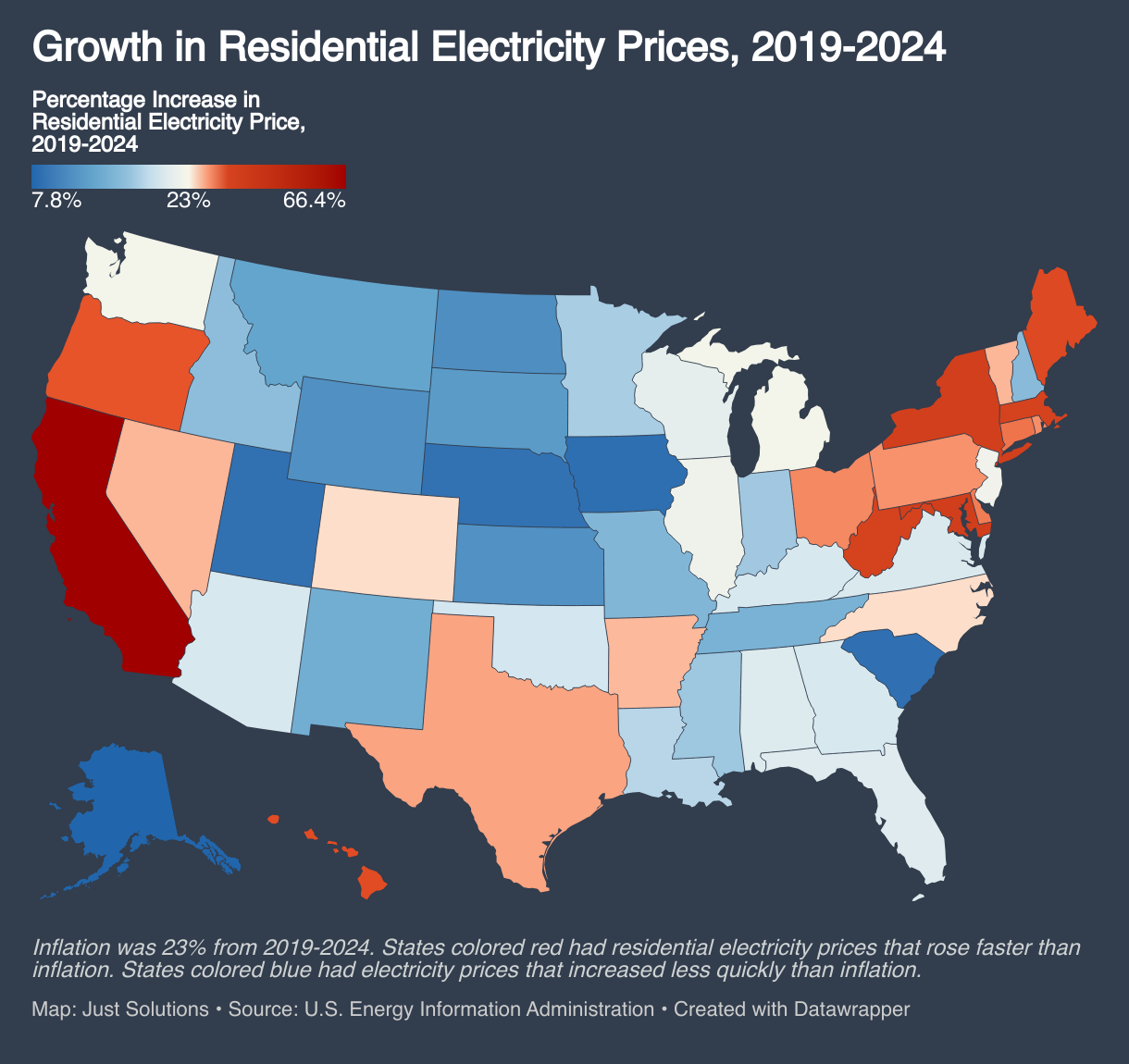
A home solar system that you purchase “locks in” your electric rates for up to 25 years, potentially reducing your effective rates now and protecting from future increases. Using data from energy.gov, a solar and battery system in 2024 had an effective electric cost of $0.26 per kWh ($0.14/kWh for a solar-only system) for the life of the system. In California and Massachusetts, this is lower than current rates. In Connecticut and Alaska, this is about the same as current rates - but these will rise over time. In Idaho and North Dakota, this is higher than current rates, even for a solar-only system, so solar may make less sense.
Defining “worth it": Are cost savings the only benefit?
Definitely not. Power outages are increasing substantially, and a solar plus battery system can provide power when the electric grid fails.
Are there other benefits to solar? Yes:
- Homes with installed solar sell for more - 4.1% - 6.9% more - A couple sources that support this.
- Solar means less pollution - using electricity generated from the sun means less pollution and carbon from other “dirty” sources.
How solar panels work - The basics
Residential solar systems convert sunlight into electricity using rooftop photovoltaic (PV) panels. When sunlight hits the panels, they generate direct current (DC) electricity. An inverter converts this DC power into alternating current (AC), which homes use to run appliances and lighting. The system first supplies power to the home; any excess electricity can charge a battery or flow to the utility grid. When solar production is low, the home automatically draws electricity from the grid or stored battery energy. Monitoring software tracks production, consumption, and system performance in real time. To provide backup during outages, a transfer or backup switch disconnects the home from the electric grid in order to safely feed the house from the solar + battery system.
Understanding the basics of how a solar system works helps households save money by: choosing the right system configuration and size for solar panels, inverters, and battery storage. Knowing when solar panels produce the most power, when electricity rates are lowest (to use power from the grid) and export rates are highest (to send power to the grid) and what incentive programs are available can result in higher savings and shorter payback periods.
The financial case: Breaking down the ROI
The cost of inaction
The average US household is expected to spend $67,000 over the next 25 years on electricity (assuming current inflation rates around 2.7%). Buying an EV would increase this (but would save money on gas).
Solar system cost
An average solar system, expected to last 25 years, costs $15k–$35k without incentives, depending on size and location.
And on average, solar systems are sized to offset about 75% of electric costs, saving $50,000 on average in electric bills over 25 years.
Average US home monthly electric use = 900kWh/mo (eia)
Average solar system size = 9.3kW - 4-11kWh (LBL)
Average solar system cost = $3.5/W (cash) - $15k-$35k (LBL)
Over 25 years, on average, solar is worth it financially in savings alone.
Many people look at the Payback Period:
Payback period is the time it takes to “earn back” enough electricity bill savings to equal the money spent on a solar system. On average, payback periods for a solar and battery system are about 10 years.
Home resale value
As mentioned above, purchasing a residential solar system can increase the resale value of your home - The "solar premium" — by 4-7%. For the median US home worth $410k, that would amount to about $16k to $28k in increased value - earning back about 80% of the cost of the system.
So on average over 25 years, going solar:
- Saves at least $15,000 on electric bills after paying back the cost of the system.
- Increases a home’s value by over $16,000.
But, whether a solar system is worth it for you depends on many factors - which we’ll look at next.
How much do solar panels cost?
A home solar system is made up of more than solar (PV) panels - and while solar panels used to be the majority of the cost of a system, the panels themselves now represent only ~12% of the system cost - and even less for solar systems with battery storage.
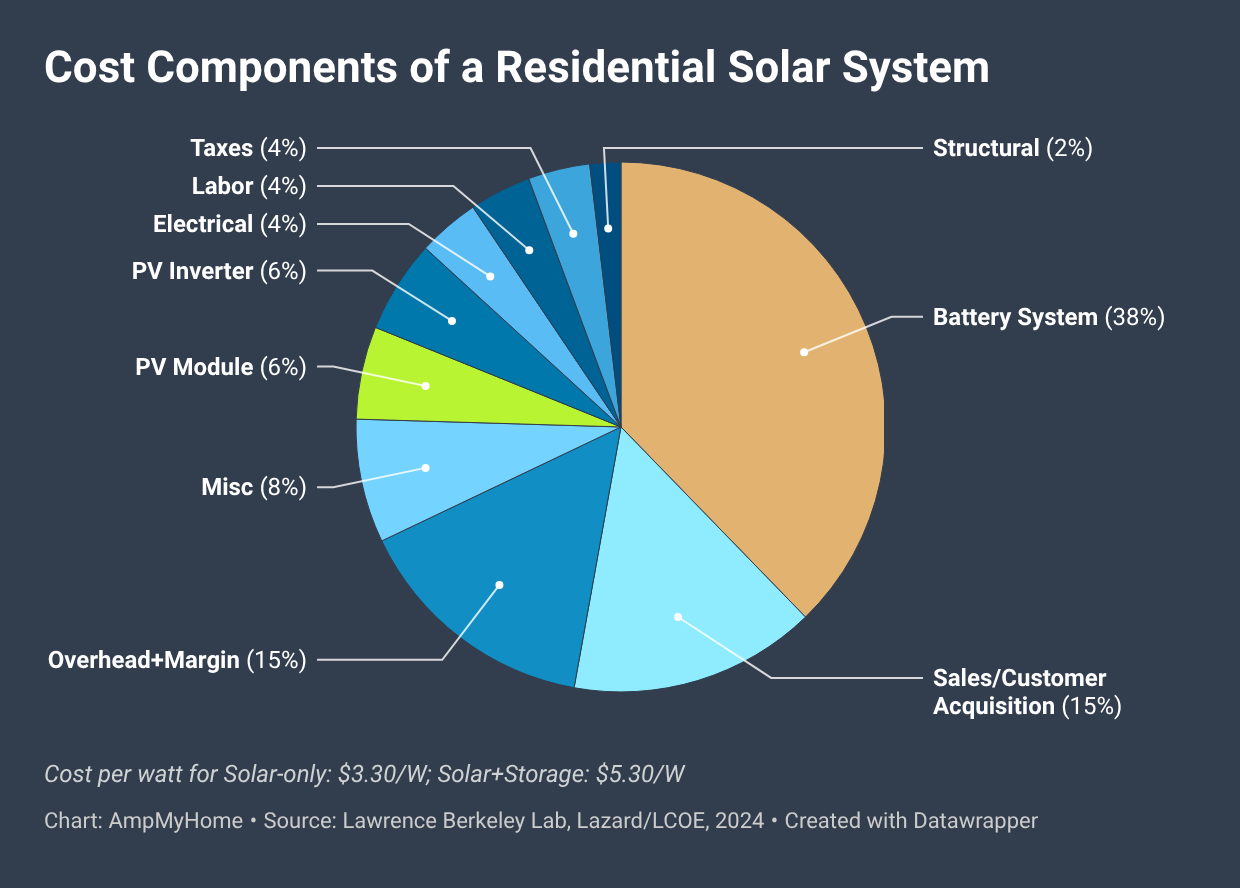
Solar panel and solar system costs are usually represented as cost per watt ($/W) to normalize for different sizes, where total rated solar system output capacity of all the solar panels together (in DC watts) is used in the denominator. Examples:
- A 400-watt rated solar panel that costs $200 would be expressed as $0.50/W.
- A 10kW (10,000 watts) solar system that costs $30,000 would be expressed as $3.00/W.
What affects solar panel system cost?
The three biggest factors going into solar system cost are size, $/watt, and whether the system includes storage. We’ll look at each of these below.
What affects solar panel system size?
- Electricity usage - How much electricity your residence uses is a big factor in determining system size - the more you use, the bigger the system is needed to offset your usage. Many utility bills will show your usage (in kWh) for the past year, broken down by month.
- Location and sunlight; roof size, pitch and shading - Where your house is located geographically, any shading of the roof, and the size, shape and orientation of the roof are all factors that will affect how much electricity is produced. Fortunately, there are online tools such as Google Project Sunroof that can answer this question for most rooftops in the US.
What affects $/watt price?
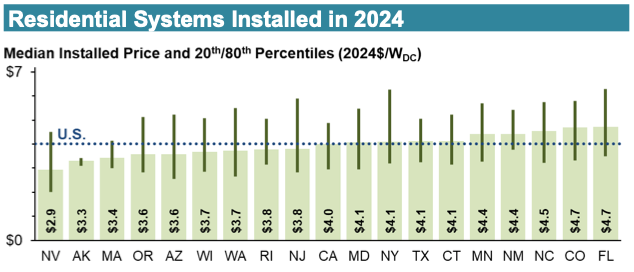
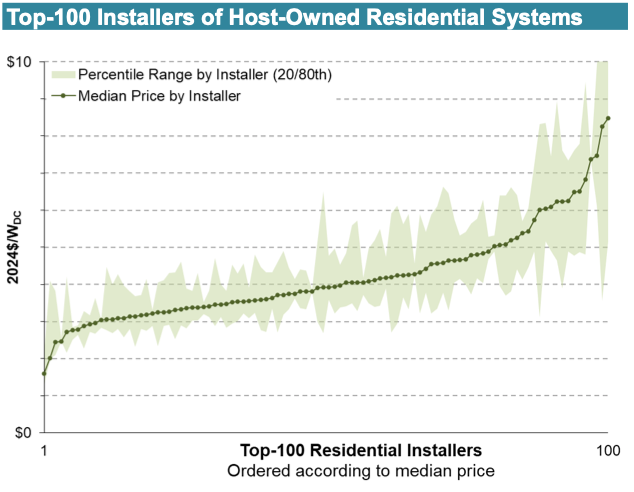
- Location - City, state, electric utility - Unfortunately, there are huge variations in cost-per-watt pricing depending on where you live. This chart from Lawrence Berkeley Labs shows the range of pricing for 100,000 solar-only installations in 2024 -
- Equipment and installer choice - Your choice of equipment and installer also plays a role in cost. For example, DC-optimizer-based systems tend to cost about 10% more than median (2023 data, LBL.gov). Different installers charge more or less depending on their business models, vendor relationships, and competition. And individual configurations for a house can all be factors in prices.
Why is home battery storage so expensive?
Adding a home battery to a solar system increases the cost by $10-20k, or more. Home batteries require more complex installations, even though the battery cell costs themselves have dropped 90% in the last 10 years. Labor costs are a big part of it; this article breaks down the battery storage system costs in more detail.
Solar incentives, tax credits, and rebates
Federal solar tax credit
Until 2026, solar and storage systems were eligible for a 30% tax credit when purchased and installed on your primary home. No longer. But, tax incentives are still available for commercial customers, who can then in turn lease battery-based storage systems to you. While these leases may include a 30% tax credit, you won’t own the system, and they may include other fees - you should look at the bottom line.
State, local and utility incentives
Some states, local municipalities and utilities offer substantial incentives - such as Duke Energy in North Carolina offering $9,000 rebates. Such attractive incentives can dramatically improve the ROI on solar + storage systems.
How incentives change the true cost of solar
Upfront incentives today are some of the strongest drivers of solar + storage adoption, as outlined in this study by inverter startup Stormentum. A site like https://www.dsireusa.org can help you find policies and incentives in your region.
How much money can solar save you?
Switching to solar is a strategic financial move that pays both immediate and long-term dividends. On average, homeowners see their monthly electric bill drop by 70% to 90%, depending on system size and energy usage.
Determining how much you can save starts with looking at how much electricity you use, and how much it costs. This information is available from your utility, either on your bills or via download using the “green button” on your utility account.
Add up the total $ spent for a year, and the total energy used (in kWh) for a year. This forms the baseline of electricity usage to offset with solar - you can calculate average cost per kWh (total spent divided by total kWh), average monthly usage and average cost per month (divide annual totals by twelve).
Online tools such as Google’s Project Sunroof can estimate specific high-level cost savings, or you can use their more advanced Sunroof API demonstration app to see more details including amount of sunlight and best panel locations for any specific home, estimate system sizing and adjust assumptions. The site https://pvwatts.nlr.gov can give you monthly electricity generation estimates for your location and system size.
To get more accurate sizing and savings estimates for your home, it’s best to get quotes from reputable solar installers, who will use your Green Button data, software and potentially on-site visits and inspections to determine optimal system size and more accurately estimate savings. (I wish there were better online tools for this).
Is a home solar battery needed?
Many people are surprised to learn early on that a solar system on the roof won’t work during a power outage. The reason for this is both to protect people working on the grid during an outage, and because more complex equipment is needed to run a house while “off grid”.
Enables electricity outage backup
A solar system with a battery backup system can provide power during an outage, by disconnecting the house from the grid and operating from solar (during the day) and the battery (at night). The solar panels can also recharge the battery during sunny periods. With increasing power outages, this is becoming a stronger driver of battery adoption.
Can save money on electricity
There are two ways adding a battery can help save more money. First, with increasingly common time-of-use electricity rates, the battery can supply power to your home when rates are high, helping avoid larger electric bills. Second, as more utilities move away from Net Energy Metering for solar, the credits given for sending power to the grid drop substantially. A battery lets you store low-cost solar energy to use later for your home, letting your home draw less power from the grid overall.
Who actually needs home batteries?
- Homes in areas with lots of power outages (hurricanes, storms, fire-safety outages)
- Areas with high time-of-use electric rates (like California)
- Areas that have moved away from Net Energy Metering (at least 9 states did this in 2025)
- People looking to avoid the cost, pollution, ongoing maintenance, potential safety issues and fueling challenges with backup generators.
When is solar worth it?
In general, solar is worth it for homeowners who:
• Face high electricity rates, or large time-of-use (TOU) rates
• Plan to own their home for the longer term
• Have good roof condition and sun exposure
In addition to Project Sunroof, NREL has a Solar Irradiance map for the US.

• Have strong net metering policies
When solar is not worth it
In general, solar is not worth it for residents who:
• Have very low electricity rates
• Rent their home, or are planning for short-term home ownership
• Have shaded roofs or roofs with structural issues
Common questions about solar - FAQ
Is solar worth it in cloudy or cold states?
Yes. Even cold, cloudy states - like upstate New York - still receive a lot of sunlight. A solar system in one of the least-sunny places in the US, Syracuse NY, can produce 6.1 MWh of electricity in a year from a 5kW system. And, solar panels are even slightly more efficient in cold weather.
Do solar panels require a lot of maintenance?
No. Solar panels are generally maintenance-free; occasional cleaning can minimize slight reductions due to dirt build-up.
Can I put solar panels on my roof?
Solar panels are very easily installed on the most common roof types, asphalt shingles. Other roof types, such as tile, metal, foam or flat-roofs require different materials and may require specialist installers - be sure to ask installers for qualifications if you have one of these other roof types.
Will solar panels damage my roof?
When installed correctly by a reputable installer, solar panels will not damage roofs. Picking a reputable installer is key.
Should I replace my roof before installing solar panels?
If you have an old roof, you should definitely replace it before installing solar panels. In general, you want 10 years or more of life remaining with your roof when installing solar panels, as the panels must be removed and re-installed when replacing a roof.
What happens if I sell my house?
If you own your solar system outright, your solar system sells with the house, and likely increases the price you get for the home. If you have a loan for your solar system, you will likely have to pay off the loan as part of the sale of your house. For leases and other solar subscription services such as Power Purchase Agreements (PPA’s) it depends on the specific contract terms - be sure to ask for details before signing on to such an agreement.
Final answer: So, is solar worth it?
Solar is worth it today for about 1/3 of all US households, who would save an average of 15% on electricity and gain outage backup with batteries, even in 2026 after the big reductions in credits (Source: Stanford study, August 2025). With incentives, lower equipment costs, increasing electricity rates, and more outages, this number of households will increase - expected to reach 2/3 of US households by 2033.
If you have high electricity rates, lots of outages and own your home - you are likely a good candidate for solar!